Robotic Spray Finishing vs. Manual Finishing: Quality, Consistency and Productivity
At Robotic Solutions, we help manufacturers find smarter ways to automate production through customized robotic solutions for the woodworking, furniture, door, and other manufacturing industries. As the exclusive U.S. partner for CMA Robotics, we specialize in robotic spray finishing systems designed to help manufacturers improve consistency, streamline production, and address finishing challenges. Whether you’re struggling with labor availability, inconsistent results, or increasing production demands, understanding the differences between robotic and manual finishing can help you determine the best approach for your operation.
A high-quality finish protects the product, enhances its appearance, and helps maintain customer satisfaction. But how does robotic spray painting compare with manual finishing, and when does automation make sense for your operation?

The Challenges of Manual Spray Finishing
Manual spray finishing remains an important part of many manufacturing operations. Skilled finishers bring experience, technique, and the ability to adapt to different parts and finishing requirements. However, relying exclusively on manual processes can introduce challenges as production demands increase.
Common challenges include:
- Inconsistent finish quality: Differences in spray technique, gun distance, speed, and overlap can affect coating uniformity from one part to the next.
- Labor availability: Experienced finishers can be difficult to recruit and retain, making it harder to maintain production capacity.
- Production bottlenecks: Finishing can become a constraint when upstream processes produce parts faster than the finishing department can handle them.
- Material waste and rework: Variations in application technique can contribute to overspray, uneven coverage, and parts that require additional attention.
- Worker exposure: Spray finishing can expose employees to hazardous chemicals and airborne coating materials, depending on the process and protective measures in place.
These challenges do not mean manual finishing is the wrong choice for every manufacturer. They do, however, create opportunities to evaluate whether robotic automation could improve the process.
How Robotic Spray Finishing Works
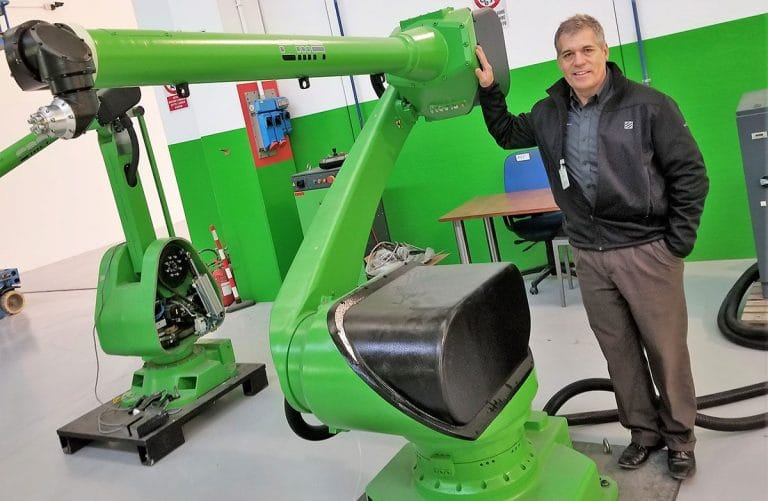
A robotic spray finishing system uses a programmed industrial robot to move spray equipment along defined paths around a workpiece. Depending on the system configuration, parts may travel through a finishing area on a shuttle, conveyor, or other material-handling system.
Modern systems can incorporate part detection, 3D scanning, automatic program generation, and specialized workpiece handling to accommodate different shapes and production requirements. CMA Robotics offers finishing solutions designed for a range of manufacturing applications, including cabinet doors, drawer boxes, furniture components, doors and other wood products.

Rather than relying solely on an operator to reproduce each spray movement, the robot follows programmed parameters designed for the specific application and coating process. The result is a finishing process that can deliver repeatable movements and more controlled application conditions when the system is properly designed, programmed, and maintained.
5 Key Differences Between Robotic and Manual Finishing
1. Finish Consistency
One of the primary advantages of robotic spray finishing is repeatability.
In manual finishing, results can vary with operator technique, fatigue, and changing production conditions. A robotic system follows its programmed path and motion parameters consistently from cycle to cycle. This repeatability can help manufacturers achieve more uniform coverage across similar parts and reduce variations associated with manual spray movements. Actual finish quality still depends on several factors, including coating selection, surface preparation, spray settings, part geometry, and proper system setup. Automation does not eliminate the need for process expertise, but it provides greater control over the robot’s movements.
2. Production Throughput
Manual finishing capacity is closely tied to the availability and workload of skilled employees. As order volumes increase, manufacturers may struggle to keep finishing aligned with the output of machining and assembly operations. Robotic finishing can help establish a more predictable production process by executing programmed cycles and coordinating with material handling. The best results come from evaluating the entire workflow—not just the spray cycle. Loading, unloading, part presentation, color changes, cleaning, and downstream handling can all affect overall throughput. For manufacturers looking to reduce finishing bottlenecks, an integrated robotic cell can help create a more coordinated production flow.
3. Labor Utilization
Robotic finishing does not necessarily eliminate the need for finishing personnel. Instead, it can change how their time is used. When a robot performs repetitive spray movements, employees may be able to focus more on preparation, quality checks, material management, system oversight, and other tasks that require human judgment. This can be particularly valuable when experienced finishers are difficult to find or when manufacturers want to reserve skilled employees for work that benefits most from their expertise. The objective is to use available labor more effectively while maintaining the quality standards customers expect.
4. Coating Efficiency and Material Waste
Coating waste is influenced by application technique, transfer efficiency, part geometry, spray parameters, and the type of coating being used. Because robotic systems can repeat defined spray paths and application parameters, they can help manufacturers establish a more controlled finishing process. With appropriate programming and optimization, this may reduce unnecessary overlap, inconsistent application, and avoidable rework. However, automation does not guarantee lower material consumption in every application. Results depend on the coating, equipment, part configuration, and how the process is engineered. A proper application evaluation should consider coating usage, transfer efficiency, finish requirements, and waste management together.
5. Workplace Safety
Spray finishing can involve exposure to airborne coatings, solvents, and other potentially hazardous substances. Robotic spray systems can help separate employees from repetitive spraying tasks and may reduce direct exposure when designed with appropriate enclosures, ventilation, and safety controls. The level of protection depends on the complete finishing system, including ventilation, filtration, personal protective equipment, and applicable safety requirements. Automation should complement—not replace—a comprehensive workplace safety program.
Can Robotic Spray Finishing Handle Different Parts and Product Designs?
A common concern among manufacturers is whether automation can accommodate the variety of parts moving through their facilities. The answer depends on the system and the production process. Some applications involve large volumes of similar parts, while others require frequent changes in dimensions, profiles, or product designs. Robotic finishing solutions can be configured for different production requirements, including systems that use scanning or automated program generation to help manage part variation.
For example, CMA Robotics offers different system configurations to suit specific finishing workflows. Shuttle-based systems, Paperbelt lines, and inverted shuttle arrangements each have distinct characteristics related to part movement, floor space, and production layout. Selecting the appropriate system requires evaluating the parts being finished, expected production volume, coating requirements, available space, and how the finishing cell will integrate with the rest of the facility.
When Should a Manufacturer Consider Robotic Finishing?
Robotic spray finishing may be worth evaluating if your operation is experiencing one or more of the following challenges:
- Finishing is limiting the output of upstream manufacturing processes.
- Recruiting or retaining skilled finishers is becoming increasingly difficult.
- Maintaining consistent quality across shifts or production runs is a challenge.
- Your operation is experiencing excessive rework or inconsistent coating application.
- Production volumes are increasing, and your current finishing process is struggling to keep pace.
- Repetitive spraying creates workplace exposure concerns.
- You want to improve the coordination between finishing and material handling.
Automation is not the right solution for every application. The best starting point is an evaluation of your current process, production requirements, parts, and finishing goals. That is where Robotic Solutions comes in – and what we excel at.
Why System Integration Matters
A robotic spray system is more than a robot and a spray gun. To achieve the intended results, the complete application must be engineered around the manufacturer’s production needs. That includes workpiece handling, spray equipment, programming, ventilation, safety systems, controls, and integration with existing machinery or conveyors.
At Robotic Solutions, we work with manufacturers to evaluate applications and develop turnkey robotic automation solutions. Our process can include application review, system layout, graphic simulation, and testing the robotic cell in our facility before installation. As the exclusive U.S. partner for CMA Robotics, we provide access to robotic finishing technology designed for a variety of manufacturing applications. Our team also supports KUKA robotic automation for machine tending, material handling, and other production tasks.
The goal is to develop a solution that fits your operation—not simply introduce a robot into an existing process.
Is Robotic Spray Finishing Right for Your Operation?
The decision between manual and robotic finishing depends on your products, production volume, quality requirements, available labor, and long-term manufacturing objectives. For some manufacturers, manual finishing remains the most practical approach. For others, robotic automation offers an opportunity to improve repeatability, better coordinate production, and reduce reliance on repetitive manual spraying. Understanding your current bottlenecks and identifying the right application are the first steps toward making an informed decision.
Ready to explore robotic finishing for your manufacturing operation?
Contact Robotic Solutions to discuss your application and learn how CMA Robotics finishing systems can help address your production challenges.
Visit www.roboticsolutions.net to learn more about our robotic finishing and manufacturing automation solutions.