7 Signs Your Finishing Process Is Ready for Automation
For many manufacturers, the idea of automating their finishing process can seem like something reserved for large production facilities with high-volume output. But that’s not always the case.
Today’s finishing automation solutions can be designed around a manufacturer’s specific production needs, product mix, available floor space, and growth goals. In many cases, the question isn’t “Are we big enough for automation?” but rather: “Is our current finishing process creating problems that automation could solve?”
If you’re experiencing several of the challenges below, it may be time to take a closer look at robotic spray finishing.

1. You’re Having Trouble Hiring and Retaining Painters
Finding skilled finishing personnel can be difficult, especially for jobs that involve repetitive spraying, handling, and other physically demanding tasks. Painting and finishing often require employees to perform the same motions for hours at a time. Recruiting people for these positions — and retaining experienced painters — can become increasingly challenging as the labor market changes. A robotic spray finishing system can take over repetitive application tasks while allowing your employees to focus on material preparation, quality control, system operation, and other higher-value responsibilities.
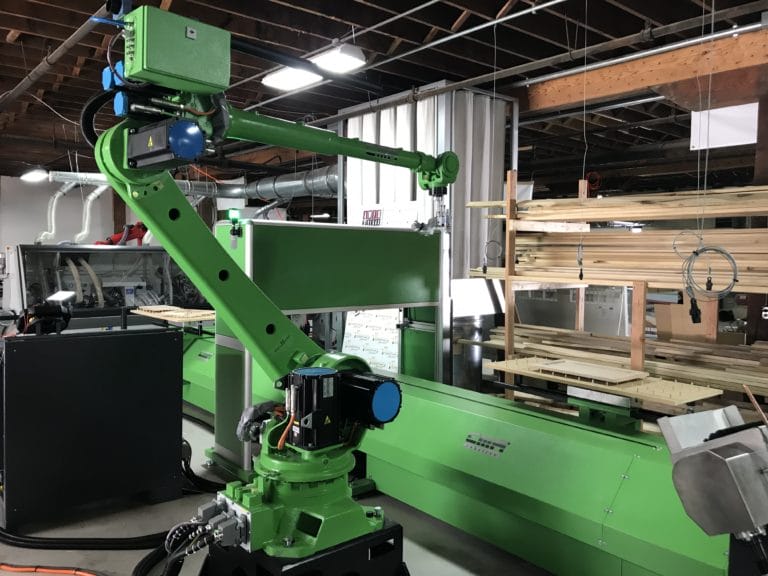
For example, CMA Robotics specializes in robotic finishing technology designed specifically for spray applications. When integrated into a complete production system, a CMA spraying robot can provide a consistent and repeatable application process while reducing the amount of repetitive work required from operators. Automation doesn’t necessarily mean eliminating employees. Instead, it can help manufacturers use their skilled workforce more effectively.
2. Your Finish Quality Isn’t Consistent
Consistency is one of the biggest advantages of industrial painting automation. A human operator’s application can vary throughout a shift. Spray speed, gun distance, overlap, angle, and material application can change from one pass to the next. Fatigue, experience level, and operator technique can all affect the final result. A properly programmed robot can repeat the same motion, speed, path, and spray pattern from part to part.
CMA Robotics’ spray technology can be integrated with robotic motion to provide a highly repeatable finishing process. The result is a process that is less dependent on who happens to be operating the spray equipment that day.
Consistent automation can help manufacturers achieve:
- More uniform coating application
- Consistent coverage
- Repeatable spray patterns
- Reduced variation between operators
- More predictable finished products
For manufacturers where finish quality is critical, that repeatability can have a significant impact on production.
3. Your Finishing Department Is a Production Bottleneck
What happens when your upstream processes can produce parts faster than your finishing department can handle them? Parts begin to pile up. Production schedules get delayed. Work-in-process inventory increases. Employees work overtime trying to catch up.
If finishing has become the limiting step in your production process, automation may provide an opportunity to increase throughput without simply adding more people. A robotic finishing system can provide consistent production cycles and help your finishing department keep pace with other areas of the plant. But implementing a robot isn’t simply a matter of purchasing a robot and putting it next to a spray booth. This is where the integrator becomes critical.
As an integrator, Robotic Solutions evaluates the complete finishing process — including the robot, spray technology, part handling, fixturing, controls, safety, and interaction with existing equipment. Working with technology such as CMA Robotics spraying systems, Robotic Solutions develops the complete automation solution around the customer’s application. The goal is to create a system, not simply install a robot.
4. You’re Using More Finishing Material Than Expected
Paint, stain, coating, and other finishing materials represent a significant operating expense. Overspray, inconsistent application, excessive coating thickness, and operator variation can all contribute to material waste. Robotic spray finishing can provide precise control over application parameters such as:
- Spray path
- Speed
- Gun distance
- Spray angle
- Triggering
- Coating application
By applying material more consistently, automation can help improve material utilization and reduce unnecessary waste. For a high-volume finishing operation, even a small improvement in material usage can become significant when multiplied across thousands of parts. Robotic Solutions can help evaluate the application process as a whole to determine where automation may improve transfer efficiency, consistency, and overall operating costs.
5. You’re Concerned About Employee Exposure and Safety
Finishing processes can expose employees to challenging working conditions, including paint and coating chemicals, overspray, fumes, and repetitive motion. Automating the spraying process can move employees away from some of the most repetitive and exposure-intensive tasks.
A properly designed automated finishing cell can incorporate appropriate guarding, ventilation, controls, and safety systems around the application process. CMA Robotics’ spray technology can become one component of that automated cell, while Robotic Solutions handles the integration of the various components into a complete production system.Safety requirements vary depending on the coating materials, equipment, and application, so every automated finishing project should be engineered around the specific process and applicable safety requirements.
The objective is simple… let automation handle the repetitive finishing task while your employees manage and monitor the process from a safer position.
6. Your Labor Costs Keep Increasing
Labor is one of the largest ongoing expenses in many manufacturing operations. As wages increase, the cost of adding another employee to keep up with production increases as well. Overtime, turnover, training, and recruiting can add additional costs that aren’t always reflected in an employee’s hourly wage.
Automation can change that equation. Instead of adding labor every time production increases, manufacturers can use automation to increase capacity and make better use of their existing workforce. This is where calculating the potential return on investment (ROI) becomes important.
The value of automation isn’t simply the cost of replacing one employee with a robot. It can include:
- Increased production capacity
- Reduced overtime
- Improved finish consistency
- Reduced material waste
- Lower labor requirements per part
- Greater production flexibility
Robotic Solutions can help manufacturers evaluate these factors when determining whether a robotic finishing system makes financial sense.
7. Your Order Volume Is Growing
Growth is a great problem to have — but it can expose weaknesses in a production process. If orders are increasing and your finishing department is already operating near capacity, adding more volume could put even more pressure on your team. This is often the point where manufacturers begin looking at automation.
A robotic finishing system can provide additional capacity while giving manufacturers a more scalable production process. Instead of continually adding labor as volume increases, automation can provide a consistent production resource that works alongside your existing team. And you don’t necessarily need massive production volumes to benefit. The right solution depends on the parts being finished, product mix, cycle times, coating requirements, available labor, floor space, and desired production capacity. That’s why working with an experienced integrator is so important.
Why the Integrator Matters
A successful robotic finishing project involves much more than selecting a robot. The robot is one component of the overall system. As the integrator, Robotic Solutions works with manufacturers to understand their process and determine how automation can fit into their existing operation. That may include integrating a CMA Robotics spraying robot with part handling, conveyors, fixtures, spray equipment, controls, safety systems, and other production equipment. The result is a turnkey automation solution designed around the application.
CMA Robotics provides the robotic spray technology. Robotic Solutions brings the technology together into a complete manufacturing solution. That distinction matters. Every finishing application is different, and the right automation solution needs to account for the way parts enter the system, how they are positioned, what coating is being applied, how the robot needs to move, how parts exit the system, and how the automation fits into the rest of the production process.
So, Is Your Finishing Process Ready?
If you recognized your operation in several of these signs, it may be worth exploring automated finishing systems. That doesn’t automatically mean you need a robot tomorrow. The first step is understanding whether automation makes financial and operational sense for your specific application.
Robotic Solutions can help you evaluate your current process, identify opportunities for automation, and develop a solution around your production requirements. With CMA Robotics spray technology and Robotic Solutions’ integration expertise, manufacturers can move from a manual finishing process to a more consistent, repeatable, and scalable operation.
Ready to See If Your Process Is a Good Fit?
If you’re experiencing labor challenges, inconsistent finishes, production bottlenecks, material waste, or increasing demand, let’s talk.
Robotic Solutions can help you determine whether robotic spray finishing makes sense for your operation — and what an automated finishing system could look like for your process.
Talk to Robotic Solutions about your finishing application → CONTACT US TODAY!